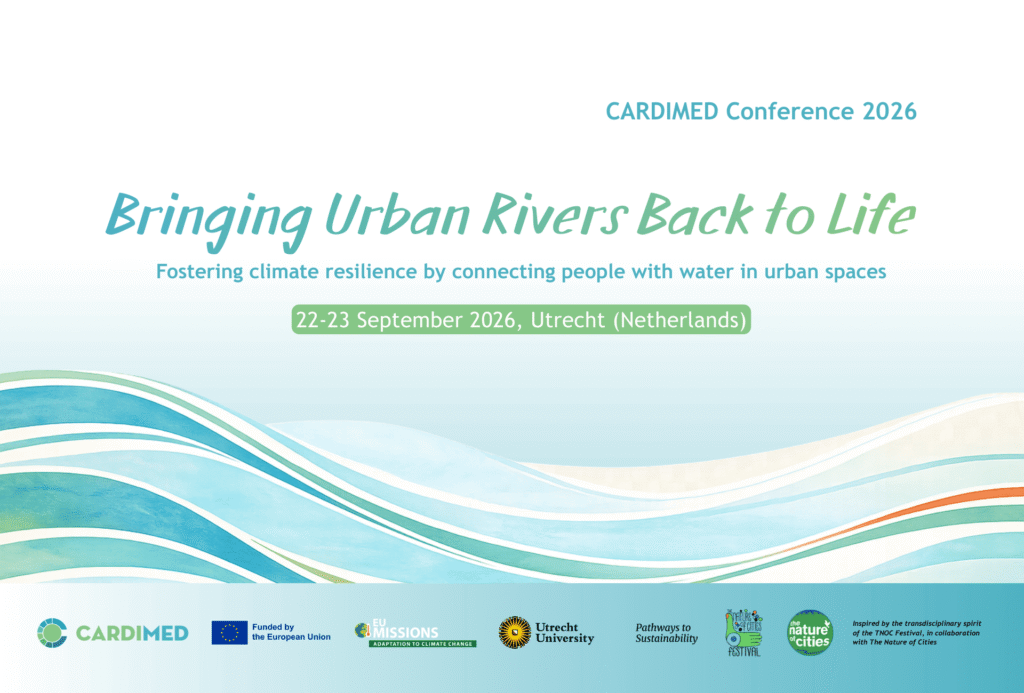
Fostering climate resilience by connecting people with water in urban spaces
22–23 September 2026 | Bar Beton, Utrecht (The Netherlands)
Cities with rivers are beginning to see their urban waters anew. Across the world, municipalities and communities are questioning decades of canalisation and turning toward daylighting, ecological restoration, and the re-imagining of river corridors as vibrant socio-ecological spaces. Through voluntary dialogues, collective action, and creative resurfacing practices, urban groups are rekindling relationships between people and their waterways.
Against this backdrop, CARDIMED, in collaboration with Utrecht University and its Pathways to Sustainability programme, is organising the international conference “Bringing Urban Rivers Back to Life”, to be held on 22–23 September 2026 at Bar Beton, Utrecht.
Urban rivers, long treated primarily as infrastructure, are re-emerging as arteries of imagination—spaces where ecological regeneration, cultural meaning, and urban transformation converge. In an era defined by climate change and biodiversity decline, cities are searching for regenerative spaces that can address environmental challenges while supporting recreation, public health, and social connection. At the same time, bottom-up initiatives and civic networks are championing swimmable urban rivers—and, with them, swimmable cities.
The conference will bring together researchers, practitioners, planners, policy makers, and artists to explore what it truly means to bring urban rivers back to life: to renature, regenerate, and daylight them; to rethink governance and planning; and to co-create a shared manifesto for the rights to urban rivers. Through diverse case studies and interdisciplinary dialogue, participants will expand collective understanding and imagination around the future of urban rivers.
- Location
- Bar Beton at Utrecht Rijnsweerd, Pythagoraslaan 101
- Entrance fee
- Registration is free but we kindly request that you only register if you are willing and able to attend the conference. Participants who register and are absent might be asked to pay a fee to cover catering and logistics costs due to food waste.
- Registration
Programme
Tuesday 22 September
| 09:00-09:30 | Registration
Collect material at registration desk at Bar Beton at Utrecht Rijnsweerd, Pythagoraslaan 101 |
| 09:30-10:00 | Opening of Conference
Niki Frantzeskaki (Utrecht University) & David Maddox (The Nature of Cities, USA) |
| 10:00-10:30 | Musical Interlude |
| 10:30-11:15 | Plenary Session 1
Learning from the past and present: Urban River Renaturing Facilitation: Niki Frantzeskaki (Utrecht University) Keynote: Wim Voogt (OKRA, The Netherlands) Panel members: Joao Sardinha (Intermunicipal Community of Alentejo Central (CIMAC), Portugal); Elrik Du Saillant (Euro-Mediterranean Water Information System (SEMIDE), France); Anne Beaulieu (Copernicus Institute for Sustainable Development at Utrecht University, The Netherlands) |
| 11:30-13:00 | Seed Sessions 1
DetailsSEED 1A:Tensions, Trade-offs and Ways Forward in the Transformation of Urban Waterways with Nature-based Solutions Charlotte Stijnen (Utrecht University, The Netherlands); Loan Diep (Urban Systems Lab NYU, USA); Paula Jimenez (Traza Consultario, Spain); Gonzalo Pradilla (Leibniz Universität Hannover, Germany). This session is focussed on the tensions and trade-offs that may emerge in the processes of transforming urban waterways with NBS. Tensions in the planning and governance of urban river restoration processes can be multidisciplinary, cutting across diverse themes including issues of urban landscape planning, governance processes, and importantly, how tensions are embedded in issues of politics and justice. SEED 1B:What the river knows: Designing novel knowledge infrastructures for monitoring urban rivers Anne Beaulieu (Utrecht University, The Netherlands); Lisette de Senerpont Domis (Netherlands Institute of Ecology (NIOO-KNAW), The Netherlands). The aims of the session are to: gather different kinds of actors to formulate novel design principles to develop better (in the sense of more pluralistic and responsive) approaches to monitoring; reflect on how monitoring contributes to connecting NBS, biodiversity, regeneration and the constitution of liveable futures; and help meet knowledge needs of cities and bottom-up initiatives by providing elements of a knowledge infrastructure for monitoring to both inform and engage. SEED 1C: Urban river regeneration in the Global South: governance, justice and locally led adaptation in vulnerable territories Pedro Torres, UNESP/USP, Brazil; Luciana Travassos, Federal University of ABC, Brazil; Erich Wolff, Utrecht University, The Netherlands; Stefano T.L Silveira, USP, Brazil; Isabela Kojin, UNESP, Brazil; Bárbara Frutuoso, Federal University of ABC, Brazil; Mariana U. de Freitas, Federal University of ABC, Brazil; Fahima Salam, University of Evora, Portugal. This session addresses planning/governance and politics/justice dimensions by exploring how urban river regeneration and renaturing processes are designed, governed and contested. It focuses on emerging experiences in vulnerable and peripheral territories, highlighting locally led adaptation (LLA) initiatives and their interaction with legal frameworks and public policies. By unpacking tensions, opportunities and inequalities, the session debates how Rights to and for Nature are mobilized in practice, and assesses adequacy, effectiveness and feasibility of these approaches in the context of climate change adaptation. SEED 1D: Living Labs as Shared Ecosystems: Lessons from Governance Pathways for Nature-based Solutions across Mediterranean socio-ecological systems Eylem Keskin, (İzmir Institute of Technology (IZTECH), Turkiye); Zeynep Özçam, (İzmir Institute of Technology (IZTECH), Turkiye); Özge Yaylalı, (Doğa Derneği (Doga Foundation), Turkiye) The session centres on the insights from the case study of Doğa Okulu (The School of Nature) in İzmir, Turkey, conducted under the EU Horizon ASSETS project, as a concrete example of how a living lab operates in practice to support Nature-based Solutions (NBS) within local contexts. It examines how Doğa Okulu functions as a multi-stakeholder, knowledge co-producing platform that brings together ecological education, agroecological practices, and local production supports to shape NBS governance. Building on this case, the session expands the discussion by engaging participants in cross-case exchange across Mediterranean contexts, fostering shared learning on governance practices, challenges, and conditions for supporting NBS implementation through community-based learning, ecological knowledge, and practice. |
| Lunch | |
| 14:30-16:00 | Seed Sessions 2
DetailsSEED 2A: Reimagining Urban Rivers: Art, Participation, and More-Than-Human Relations for Nature-Based Solutions and Community Stewardship Elena Marie Enseñado, (Erasmus University, The Netherlands); Maurice Specht, (Buitenplaats Brienenoord, The Netherlands); Rosanne Van der Voet, (Leiden University, The Netherlands); John Hanna, (TU Delft, The Netherlands); Genesis Daquinan, (Leiden University, The Netherlands); Tannya Pico, (Institute for Urban Excellence, The Netherlands). Urban river restoration is often driven by technical solutions, yet many projects struggle to build lasting community stewardship. This session explores how art and participatory practices can strengthen Nature-Based Solutions (NBS) by deepening relationships between people and urban rivers. Focusing on more-than-human relations, it highlights the social dimensions of water through case studies from Rotterdam and Quito. Participants will engage in interactive discussions on art, participation, and more-than-human relations. A hands-on workshop introduces creative methods to foster awareness, reflection, and community stewardship. SEED 2B: From awareness to governance: coproducing river basin regeneration in water-scarce Mediterranean territories Stephanie Rosenkranz, (Utrecht University School of Economics, The Netherlands; Movimento Rigenerazione Asinaro, Italy); Giusy Pappalardo, (Università degli Studi di Catania, Italy; Universtitat Autònoma de Barcelona, Spain); Thieu Besselink, (Utrecht University Honours College, The Netherlands; Movimento Rigenerazione Asinaro, Italy); Natasha Owen, (Movimento Rigenerazione Asinaro, Italy); Laura Saija (Università degli Studi di Catania, Italy). This session examines how communities in water-scarce Mediterranean territories can move from cultural mobilisation around a river to genuine coproduction of its governance. Centring on a grassroots initiative in south-east Sicily and drawing on a decade of action research in the neighbouring Simeto River Valley, we explore the transition from awareness-building to SEED 2C: Listen to the rivers speak: Drink the city: Regenerate the world Duncan Crowley, (DINÂMIA’CET and CE3C, University of Lisbon, Portugal); João Dinis, (Climate Action Director at Cascais Municipality, Portugal); Gil Pessanha Penha-Lopes, (CE3C, University of Lisbon, & “Mira River – A Living Being with Legal Rights”, Portugal); Andresa Lêdo Marques, (Institute of Social Sciences Lisbon (Naturescapes project), Portugal); Adolfo Chautón Pérez, (Doughnut Economics Action Lab (DEAL) & Donut Spain, Portugal). Bringing together a small part of the “Little Portugal ‘Guarda Rios’ Network” (River guardians / kingfishers), who are all working on different rivers that flow in Portugal, in different locations, and at different scales, all with different histories and challenges. This session mostly relates to planning and governance & politics and justice in rivers. The Alcântara and Sever communities from part of the wider Tagus bioregion. The Sever River forms part of the Portuguese – Spanish border where greater challenges exist. The Rio Mira is Portugal’s first river community seeking “Rights of Nature” legal recognition. SEED 2D: From Invisible to Visible: Capturing and Communicating Perceptions of Nature-Based Solutions for Water Management Kyra Gmoser-Daskalakis, (Utrecht University, The Netherlands); Jessica Lillquist, (Utrecht University, The Netherlands); Katrin Merfeld, (Utrecht University, The Netherlands). This session brings together experts from two EU funded projects studying stakeholder perceptions of nature-based solutions. Together we unite our efforts to generate new opportunities for stakeholder engagement and to enhance diverse contributions to the planning and governance of nature-based solutions. Through an interactive workshop, participants will engage in a mental modelling exercise helping to inform and design potential communication strategies focused on urban river management. |
| 16:30-18:00 | Plenary Session 2
Transforming urban rivers with nature-based solutions Facilitation: Claudia Misteli (The Nature of Cities, Barcelona) Keynote: Simos Malamis (NTUA, Greece) Panel members: Kostas Petrakos (MEDINA, Greece); Luciana Travassos (UFABC, Brazil); Abraham Ortega (Reimagining Genil River, Spain); Agata Alcara (Reimagining Genil River, Spain) |
| 18:00-19:00 | Co-creation with Arts
Facilitation: Timon Vader (Utrecht) |
| 18:45-21:00 | Conference Dinner |
Wednesday 23 September
| 08:30-09:00 | Walk-in with coffee |
| 09:00-10:30 | Seed Sessions 3
DetailsSEED 3A: Relating with rivers: rivers as living entities Judy Bush, (University of Melbourne, Australia; Melissa Pineda Pinto, University of Melbourne, Australia); Andreanne Doyon, (Simon Fraser University, Australia); Sareh Moosavi, (University of Melbourne, Australia). This session adopts a biocultural theoretical lens to consider how politics and justice is addressed in river restoration and protection processes. In Australia, recognition of Birrarung (Yarra River) as an integrated living entity also includes foregrounding Traditional Owners as the voice of the river. This recognition extends justice and recognition to the more-than-human, and asks us, as residents, researchers and practitioners, to consider our relationship with Birrarung. How does this influence how we think about other rivers, in very different contexts? SEED 3B: The choice is yours! Canalized or meandering rivers? Jorine Oosting, (Puur Water & Natuur (PWN)), The Netherlands; (Mathijs van Eeuwijk, Zuidas Municipality of Amsterdam, The Netherlands); Charlotte Offringa, (Utrecht University, The Netherlands). In this serious game, participants explore what it takes to restore meanders in a canalized river system. Players must secure the support of diverse stakeholders by negotiating trade-offs, forming coalitions, and making strategic decisions for river regeneration. With the 2027 deadline of the European Water Framework Directive approaching, time pressure adds urgency to both planning and implementation. The session highlights the opportunities and tensions inherent in multi-stakeholder collaboration, offering hands-on insight into real-world governance challenges. It directly aligns with the conference theme of Planning and Governance by focusing on decision-making in complex, multi-actor environments. SEED 3C: Caring Networks as Infrastructure for Watershed Governance Loan Diep, (Urban Systems Lab, New York University, USA); Mateo Villegas, (Trophica Lab, University of British Columbia, Canada). This seed session explores grassroots, caring initiatives as an essential part of urban river governance. Everyday environmental labor sustains ecosystems and fills critical governance gaps, yet remains invisible and uncompensated. We argue that caring networks constitute essential infrastructure for river regeneration, and that mapping them is a key tool for operationalizing recognitional justice. Drawing on Bogotá’s municipal platform of ‘caring blocks,’ we explore how connecting grassroots initiatives across scales can transform multi-level governance. A central aim of the session is to collectively explore with participants how similar mapping methodologies can be adapted and applied in their own cities. SEED 3D: A decolonial praxis for urban river regeneration: key insights derived from rivers across the Caribbean Janneke den Dekker-Arlain, (Utrecht University, The Netherlands); Mandy Kuhn, (Arizona State University, USA; Anne Galvin, St. John’s University, USA); Tim Lüschen, (The Nature of Cities Festival; Rights of the Spree, Germany). Our session expands on the debate over transformations in urban river regeneration projects, bringing a Caribbean perspective to the politics of space and the rights to nature. We ground our analysis through a decolonial lens, broadening our understanding of both justice and politics. Through our work, we show not only what we can learn from river regeneration projects in the Caribbean but also what our framework reveals about our case studies. |
| 11:00-12:15 | Plenary Session 3
Global Perspectives on Transforming at Scale Facilitation: Erich Wolff (Utrecht University) Keynotes: Pedro Torres (USP, Brazil) & Judy Bush (Melbourne University, Australia) Panel members: Francesca Ferlicca (Sciences Po Paris, France); Anuj Jain (National University of Singapore, Singapore); Charlotte Stijnen (Utrecht University, The Netherlands) |
| 12:30-13:00 | Final Plenary
Manifesto of Bringing Rivers Back to Life Niki Frantzeskaki (Utrecht University, The Netherlands) & David Maddox (The Nature of Cities, USA) |
| 13:00-14:00 | Lunch |
| 14:00-16:30 | Field Trips
DetailsField Trip A – Utrecht Science Park: Improving biodiversity in action Coordinator: Geertje Speelman, Guide: Dorinne Raaimakers. Since 2021 Utrecht University is striving to create a university where biodiversity is visible on campus and is an integral part of all decisions. Part of this strategy is to improve the habitat of twenty icon species, so they can settle permanently in Utrecht Science Park no later than 2035. These species were originally found in the area. If they feel at home at Utrecht Science Park again, the same goes for hundreds of other species: a sign that the ecosystem on campus is healthy. Dorinne Raaimakers, will take you on a tour around Utrecht Science Park and share what actions Utrecht University is taking to improve biodiversity and climate adaptation. Field Trip B – Catharijnesingel: Restoring urban rivers in practice Coordinator: Nina Panousi, Guide: Wim Voogt, (OKRA). Every city has a heartbeat. In Utrecht, it has not always sounded the same. Catharijnesingel tells the story of shifting urban priorities. Water has given way to asphalt, and asphalt has once again made room for water, what many stakeholders involved in the canal’s restoration have discarded as “mistakes made in the past”. Today, Catharijnesingel stands as a symbol of urban transformation towards sustainability and climate resilience. More than an engineering achievement, it is a momentous accomplishment, constituting a major milestone in Utrecht’s pursuit of a more resilient, inclusive, and liveable city landscape. We invite you to meet the people behind the canal’s restoration and discover how bringing nature back to the city centre has influenced everyday realities in Utrecht. Field Trip C – Utrecht Canals: Learn about initiatives supporting nature in Utrecht’s waterways Coordinator: Charlotte Stijnen, Guide: Mark van Heukelum The canals in the center of Utrecht connect two rivers, the Kromme Rijn and the Vecht, thereby making the canals part of the river system. Despite the hard embankments of the canal edges, there are many practices that can support nature in these waters. Learn about innovative initiatives that increase ecological connectivity and enhance biodiversity in the Utrecht canals. The tour will be guided by ecologist Mark van Heukelum, who will tell us more about the importance of these initiatives and which species live in the canals. We will pass by the internationally renowned ‘fish doorbell’, an eco- friendly riverbank, and a reef made from the stones of the Dom Tower. |
| 16:30-18:30 | Borrel – Drinks and Snacks |