MedINA is an environmental organization founded in 2003, dedicated to promoting the harmonious coexistence of people and nature across Greece and the Mediterranean. Their work lies at the intersection of environmental protection, cultural heritage, and community empowerment, guided by a holistic approach that connects scientific knowledge with traditional wisdom. They recognise that today’s global challenges – ranging from climate change and biodiversity loss to water scarcity, poverty and inequality – require solutions that engage local people as active stewards of their natural and cultural landscapes. For this reason, we work closely with farmers, local authorities, schools, civil society groups and scientific experts to translate research into accessible knowledge and to elevate practices that support resilient ecosystems.
Their priorities focus on protecting and restoring ecosystems, strengthening biodiversity, safeguarding cultural identities and enabling communities to design sustainable, locally grounded solutions. In freshwater and agroecosystems, they collaborate with universities, research institutions and international networks such as IUCN, AMNC and the Mediterranean Alliance for Wetlands in order to advance knowledge, inform policy and promote climate adaptation. Through this work, they envision a future in which prosperity and nature thrive together and where innovation and traditional knowledge work in synergy.
Their “Let it Flow” programme provides the umbrella framework for MedINA’s river-related work, including the dry-stone weir initiatives implemented in CARDIMED. The programme aims to defend the integrity of Greek rivers and streams through research, policy advocacy and on-the-ground restoration actions. It recognises rivers not only as ecological corridors, but also as cultural landscapes that shape community identity.
Through collaborative work with scientific institutions, local communities and civil society organisations across Greece and Europe, the programme aims to strengthen institutional protection for rivers and address threats such as the proliferation of small hydropower plants in key basins. It has contributed to the establishment of initiatives including the proposed Transboundary Wild River Park in the Aoos/Vjosa basin, while also encouraging legislation for removing barriers and restoring river connectivity. This work has enabled the first complete barrier mapping of a river basin in Greece, has created alliances of civil society organisations, aims to identify critical no-go areas in Greece for future hydropower spatial development based on biodiversity and river connectivity indices, and has supported restoration interventions such as the construction and rehabilitation of dry-stone weirs in island streams. At the same time, through the “Let it Flow” program they mobilise citizens, schools and local groups to engage in monitoring, stewardship and education, and highlight the importance of island streams as essential components of both natural ecosystems and local identity.
Dry-stone weirs, or micro-dams, are low stone structures built across ephemeral streams. They slow down runoff, reduce flow velocity, create small upstream ponds, and enhance infiltration. Historically used for irrigation and flood mitigation, they represent a deeply rooted Mediterranean practice combining water management, local materials and community craftsmanship.
This tradition has ancient origins, with early examples found in Crete during the Minoan period. In more recent times, the celebrated project in Apeiranthos, Naxos, led by Manolis Glezos between 1987 and 1994, demonstrated the effectiveness of constructing networks of small stone weirs for revitalising aquifers, reducing erosion and supporting agriculture. This work later inspired similar applications in other parts of the Mediterranean.
Building on this heritage, MedINA has reintroduced the practice as a contemporary Nature-based Solutions. In Kythera, the restoration of stone weirs in the Karavas stream led to the immediate return of surface flow after years of drought and enhanced local biodiversity, and in 2025 this technique is being incorporated into the design of post-wildfire erosion-control works on the island. In Paros, the Kavouropotamos stream project in 2022 involved the construction of 34 weirs combined with workshops, artisan training and biodiversity monitoring, carried out in collaboration with WWF and Boulouki. In Ios, as part of the Med-RESET project in 2024, 80 stone weirs were constructed through a participatory learning programme that included apprenticeships and community events. These experiences formed the technical and conceptual foundation for the CARDIMED intervention in Sifnos.
In Sifnos, MedINA implemented the construction of 120 traditional dry-stone check dams across two ephemeral streams, integrating a traditional technique into a modern climate-adaptation framework. The intervention aims to slow down runoff, reduce flood risk, enhance infiltration and aquifer recharge, prevent erosion, support biodiversity and strengthen local identity through the revival of traditional craftsmanship. The project combines participatory construction methods, the transmission of traditional knowledge and a modern monitoring network that includes water-level sensors in wells and streams, a weather station and soil-moisture sensors. These monitoring instruments are currently collecting baseline data that will allow us to quantify the impact of the check dams on groundwater recharge and flood mitigation during the 2026 monitoring period. In addition, community engagement played a central role in the successful implementation of the project; public events, school visits, volunteer participation and structured interviews ensured that the intervention was shaped by local perspectives and fostered a strong sense of community ownership.
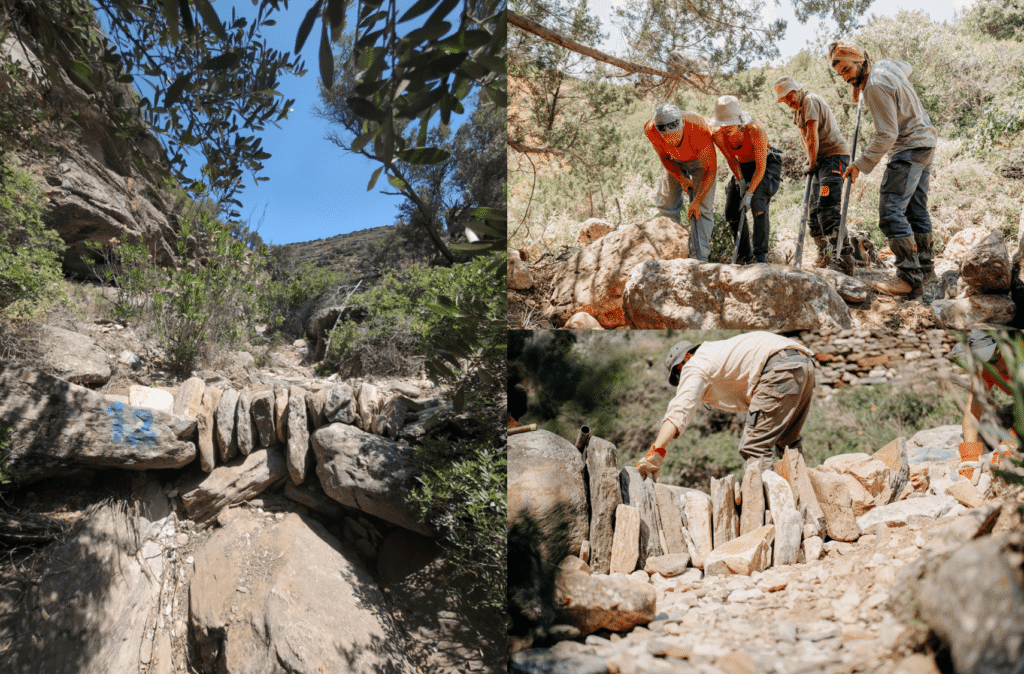
Figure 1: Highlights from check dams’ construction in Sifnos
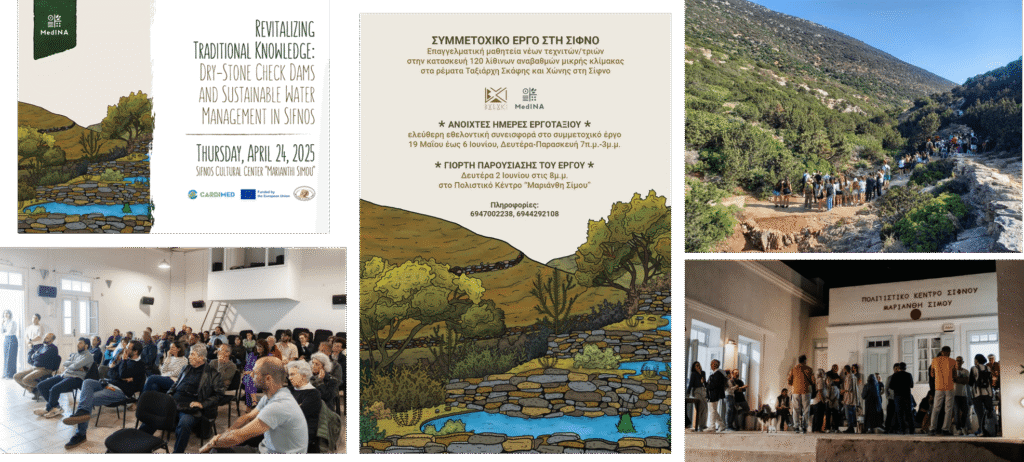
Figure 2: Outreach activities in Sifnos
A defining feature of the Sifnos intervention is the innovative methodology used to select the locations for the 120 check dams. The approach combined extensive field surveys with a high-resolution UAV-drone scan of the watershed and the creation of a 5cm-resolution Digital Terrain Model, which significantly improved upon the existing 5m dataset provided by the National Cadastre. This enhanced spatial precision allowed us to run hydraulic simulation models that identified the points offering maximum benefit in terms of flood mitigation, infiltration potential and safe crossing access for farmers. The modelling results aligned closely (around 80%) with the positions identified through fieldwork. The remaining locations were finalised directly on site, reflecting an effective synthesis of scientific analysis and traditional landscape knowledge.
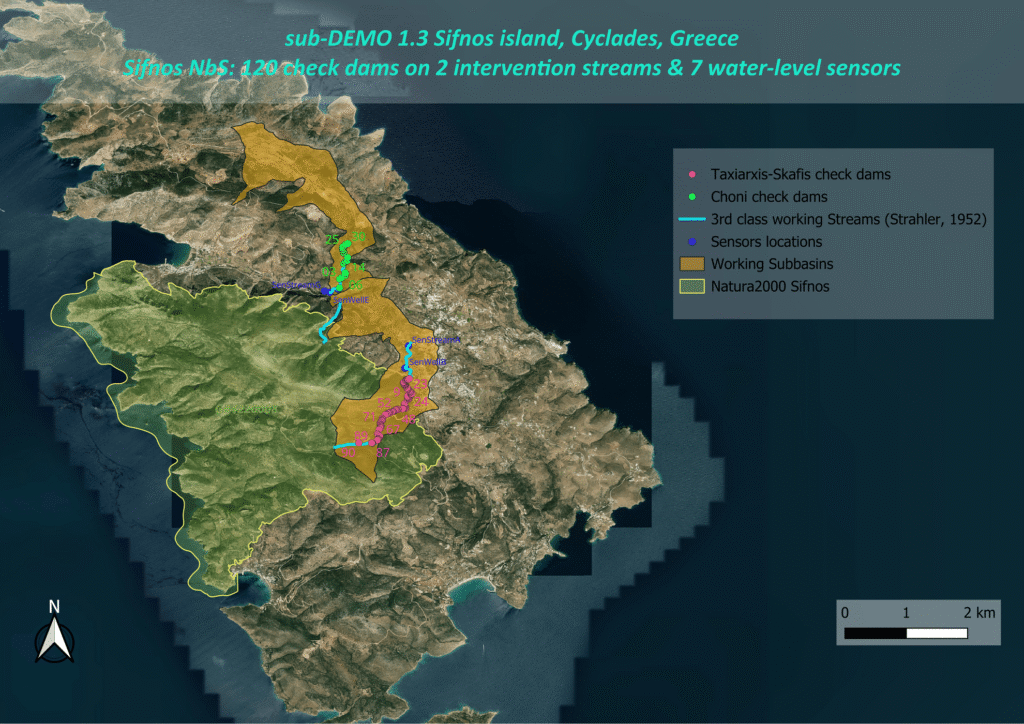
Figure 3: Sifnos NbS system intervention
Traditional stone weirs provide a simple yet effective Nature-based Solution that enhances water retention, promotes infiltration and supports landscape restoration, while also revitalising a significant cultural heritage practice. On the arid ecosystems of the Mediterranean islands, the management of water is both a technical and a social challenge, linked to identity, resilience and community wellbeing. Through CARDIMED, MedINA demonstrates how traditional knowledge, enriched by scientific modelling and monitoring, can generate measurable benefits and serve as a scalable model for climate resilience across Mediterranean regions.