Author: Maria Tassi, CORE-IC
The growing frequency and severity of flooding in Greece, especially in Attica and Central Greece, needs different approaches for flooding risk management. Nature-based solutions (NBS) have emerged as an effective method for reducing flood damage and increasing ecosystem resilience. These methods use natural processes and ecosystems to manage water flow, reduce runoff, and improve the general condition of rivers. By implementing NBS into flood management initiatives, Greece could deal with both immediate risks associated with flooding and ongoing environmental sustainability (Spyrou et al., 2021).
Recognizing such a need in CARDIMED , we showcase sustainable solutions that not only mitigate floods but also support biodiversity and environmental resilience. We focus on implementing various NBSs through different Use Case sites to address, among others, flood risks and enhance ecosystem resilience. For example:
- Demo 1: “Non-conventional water loops on North-South Aegean islands” focuses on rainwater harvesting and stone weirs for regulating water flow, reducing run-off, and improving rainwater recharge.
- Demo 4: “Raingardens (SuDS) and living walls in Sicily” employs raingardens to absorb excess water, mitigating urban floods.
- Demo 5: “Micro-forests and unsealed soils in Provence-Alpes-Côte d’Azur” integrates micro-forests and unsealed soils for increasing water infiltration and improving urban resilience against extreme weather events.


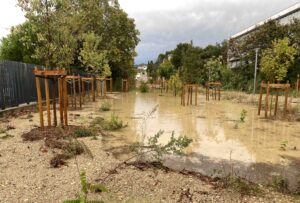
NBS includes a variety of methods for restoring and preserving natural hydrological systems. For example, riparian buffers, wetlands, and reforestation may significantly enhance landscapes’ ability to absorb and retain water, decreasing the quantity and speed of runoff during periods of heavy rainfall (Spyrou et al., 2022; Spyrou et al., 2021). In the Spercheios River Basin, NBS have been used to reduce the consequences of flooding and drought, proving their ability to adapt to current and future climate situations (Spyrou et al., 2022; Spyrou et al., 2021). This technique assists in flood reduction while also contributing to biodiversity protection and habitat restoration, all of which are essential for preserving the balance of nature.
The success of NBS in flood management is supported by data gathered from numerous research. For example:
- Fryirs et al. (2023) suggest that constructing flood-resilient fluvial corridors through NBS can improve rivers’ ability to survive extreme floods and recover more quickly.
- Raška et al. (2019) argue that NBS can efficiently and environmentally friendly reduce risk to many types of floods, such as riverine and flash floods.
- Integrating such concepts into existing flood protection systems can result in an additional strategy that considers both environmental and social factors.
In Greece, underestimating intermittent rivers and ephemeral streams has already led to large flooding incidents, such as the catastrophic floods that occurred in Mandra in 2017 (Stamataki et al., 2021) and in Thessaly in 2023 (Dimitriou et al., 2024). Greece could improve its flood forecasting and response abilities by implementing NBS that focus on the restoration and management of these reservoirs of water. The WRF-Hydro model, which has been applied in Attica, indicates the potential for improved flood forecasting using integrated modeling methodologies that take into account both hydrological and atmospheric interactions (Galanaki et al., 2021). This model can be supplemented with NBS that increases the natural flow and storage capacity of these rivers, lowering the risk of flash floods.
Furthermore, spatial placement of NBS within river catchments is critical to maximize their efficiency. According to recent research, an integrated system that manages floodwater sources and channels via NBS may significantly reduce flood risks (Reaney, 2022). This technique is consistent with the concepts of Natural Flood Management, which allow for modifying and restoring landscape elements to improve flood management (Monger et al., 2022). Implementing such techniques in sensitive regions of Greece can result in more resilient ecosystems.
The financial aspects of implementing NBS are also worth considering. Ternell et al. (2020) emphasize the role of financial instruments in supporting NBS initiatives, particularly in metropolitan areas where traditional infrastructure may be insufficient for managing rising dangers from flooding. By investing in NBS, Greece may lower flood risk while simultaneously creating green spaces that improve urban livability and biodiversity. This dual advantage highlights the importance of policymakers prioritizing NBS in flood risk control actions.
Additionally, including NBS into urban planning is critical for resolving the problems caused by urbanization. Impermeable surfaces in urban areas frequently cause increased runoff, increasing flooding hazards (Ferreira et al., 2020). Cities can increase their flood resistance by adding NBS such as green roofs, permeable pavements, and urban wetlands, while simultaneously improving air quality and decreasing urban heat (Ternell et al., 2020). This multimodal strategy has the potential to result in sustainable urban development that is in line with Greece’s environmental aims.
In conclusion, the implementation of nature-based solutions in Greece provides an achievable strategy for increasing flood resilience. Greece can reduce the effects of flooding while increasing environmental health by restoring natural hydrological processes, improving flood forecasting, and incorporating NBS into urban development. The empirical evidence showing the usefulness of NBS, together with the necessity for long-term flood management approach.
References:
- Dimitriou, E., Efstratiadis, A., Zotou, I., Papadopoulos, A., Iliopoulou, T., Sakki, G.-K., Mazi, K., Rozos, E., Koukouvinos, A., Koussis, A.D. et al. (2024), Post-Analysis of Daniel Extreme Flood Event in Thessaly, Central Greece: Practical Lessons and the Value of State-of-the-Art Water-Monitoring Networks,Water 16, 980. https://doi.org/10.3390/w16070980
- Ferreira, C., Mourato, S., Kašanin‐Grubin, M., Ferreira, A., Destouni, G., & Kalantari, Z. (2020), Effectiveness of nature-based solutions in mitigating flood hazard in a Mediterranean peri-urban catchment. Water, 12(10), 2893. https://doi.org/10.3390/w12102893
- Fryirs, K., Zhang, N., Ralph, T., & Arash, A. (2023). Natural flood management: lessons and opportunities from the catastrophic 2021–2022 floods in eastern Australia. Earth Surface Processes and Landforms, 48(9), 1649-1664. https://doi.org/10.1002/esp.5647
- Galanaki, E., Lagouvardos, K., Kotroni, V., Giannaros, T., & Giannaros, C. (2021), Implementation of wrf-hydro at two drainage basins in the region of Attica, Greece, for operational flood forecasting, Natural Hazards and Earth System Science, 21(7), 1983-2000. https://doi.org/10.5194/nhess-21-1983-2021
- Monger, F., Spracklen, D., Kirkby, M., & Schofield, L. (2022). The impact of semi‐natural broadleaf woodland and pasture on soil properties and flood discharge, Hydrological Processes, 36(1). https://doi.org/10.1002/hyp.14453
- Raška, P., Slavíková, L., & Sheehan, J. (2019). Scale In nature-based solutions for flood risk management, 9-20. https://doi.org/10.1007/978-3-030-23842-1_2
- Reaney, S. (2022). Spatial targeting of nature‐based solutions for flood risk management within river catchments, Journal of Flood Risk Management, 15(3). https://doi.org/10.1111/jfr3.12803
- Stamataki, M., Tzoraki, O., & Sauquet, É. (2021). Time-lapse graphical representation methods for mapping intermittent rivers and ephemeral streams (ires), European Journal of Geography, 12(1), 51-67. https://doi.org/10.48088/ejg.m.sta.12.1.051.067
- Spyrou, C., Loupis, M., Charizopoulos, Ν., Apostolidou, I., Mentzafou, A., Varlas, G., … & Kumar, P. (2021). Evaluating nature-based solution for flood reduction in Spercheios River basin under current and future climate conditions, Sustainability, 13(7), 3885. https://doi.org/10.3390/su13073885
- Spyrou, C., Loupis, M., Charizopoulos, Ν., Arvanitis, P., Mentzafou, A., Dimitriou, E., … & Kumar, P. (2022). Evaluating nature-based solution for flood reduction in Spercheios River Basin part 2: early experimental evidence, Sustainability, 14(16), 10345. https://doi.org/10.3390/su141610345
- Ternell, A., Stigson, P., Elmqvist, B., Olsson, J., Hanson, H., & Nilsson, A. (2020). Financial instruments for nature-based solutions to reduce the risks of flooding and drought, Ecocycles, 6(1), 110-133. https://doi.org/10.19040/ecocycles.v6i2.161