Climate change is exerting unprecedented pressure on Mediterranean landscapes. As temperatures increase and seasonal water shortages worsen, communities are reconsidering their approaches to managing natural resources. However, decision-makers often lack the environmental information necessary to respond effectively, especially in remote or under-sampled areas where traditional monitoring stations are sparse or absent. Low-cost, resilient environmental sensors can help fill this gap. The potential of these sensors to extend data collection well beyond the reach of expensive systems offers a practical pathway to smarter water management, climate resilience, and nature-based solutions.
Most existing monitoring networks are centred around cities, critical infrastructure, or specialised research facilities. While these stations provide reliable measurements, their limited numbers mean they often cannot capture the full complexity of natural systems, especially in:
- Rural catchments
- Agricultural landscapes
- Wetlands and coastal zones
- Semi-arid regions
Remote locations also face additional challenges:
- Limited or no power supply
- Unreliable connectivity
- Harsh environmental conditions
- Infrequent maintenance access
This is where distributed, affordable sensing becomes extremely valuable.
Before considering the broader monitoring strategy, it is useful to understand the device at the core of CiROCCO’s approach: a reliable, inexpensive environmental sensing node designed for real-world deployments across the Mediterranean and neighbouring regions. A prototype of this low-cost sensing node is shown in Figure 1.
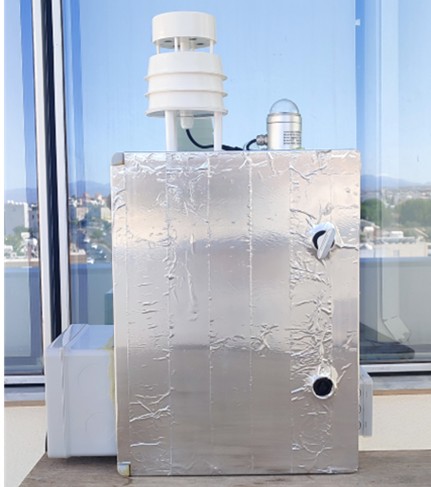
Figure 1: Prototype low-cost environmental sensing node tested within CiROCCO.
The prototypes in CiROCCO are designed for reliable performance in challenging outdoor conditions. Their design emphasises:
- Robust construction, suitable for high temperatures, dust, humidity, and long-term exposure
- Very low power consumption enables extended operation using batteries or small solar panels
- Expanded communication options (LoRa/LoRaWAN, LTE, Wi-Fi, and Satellite), tailored to site requirements
- Modularity, allowing different sensors to be added or replaced
By keeping the devices easy to deploy and maintain, CiROCCO supports environmental monitoring even in areas with limited infrastructure.
The overall concept becomes clearer with the introduction of the sensing node. The CiROCCO project is developing an integrated monitoring system that combines high-precision reference stations with a scalable network of low-cost nodes. This hybrid model offers the accuracy required for scientific credibility and the extensive coverage needed to understand complex landscapes.
This approach is being developed and validated at four Mediterranean pilot sites: Cyprus, Egypt, Serbia, and Spain, each representing different climates, terrains, and operational challenges. Testing across such diverse settings allows CiROCCO to enhance its technology for desert, agricultural, coastal, and rural areas alike.
CiROCCO employs a reference-based harmonisation process to ensure scientific reliability across a widespread, distributed network. High-quality sensing stations provide accurate baseline measurements, while low-cost sensing nodes supply dense spatial data. By combining these data streams, CiROCCO calculates the calibration coefficients that ensure high accuracy and long-term stability of the low-cost sensors. Figure 2 presents a schematic overview of the harmonisation process.
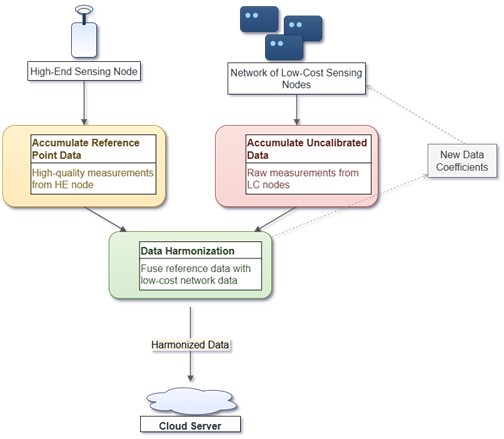
Figure 2: CiROCCO’s data harmonisation workflow. High-end reference measurements are fused with low-cost network data to generate calibration coefficients and produce harmonised environmental datasets.
Enhanced environmental monitoring benefits communities and decision-makers by:
- Optimising irrigation scheduling
- Tracking drought and heat trends
- Monitoring groundwater conditions
- Evaluating nature-based solutions
- Detecting environmental anomalies earlier
With greater spatial coverage, previously hidden patterns become visible, enabling better decisions on agriculture, water management, and climate adaptation. Because the sensing nodes are affordable, modular, and easy to deploy, organisations can expand monitoring networks without significant investment. This, in turn, makes them suitable for:
- Municipalities
- Agricultural cooperatives
- Water authorities
- Research institutes
- Local communities involved in climate adaptation processes
The technology enables multi-site, real-time environmental assessments at a lower cost compared to traditional methods. Several elements of CiROCCO’s sensing system will be incorporated into the design of the automation and control systems for CARDIMED DEMO9 activities in Cyprus, specifically for monitoring:
- Soil moisture
- Weather and microclimate conditions
- Water levels in storage tanks
- Smart irrigation control