Every year on the fourth Thursday of April, the world marks International Girls in ICT Day; a moment to reflect on the gender gap that still persists in technology and to celebrate the progress being made to close it. At ICCS (Institute of Communication and Computer Systems), and through our work within the CARDIMED project, we believe that digital empowerment and climate resilience are inseparable goals, and that girls and women must be at the heart of both.
The Digital–Climate Connection
Climate change is one of the defining challenges of our time, and the Mediterranean region feels its effects acutely: prolonged droughts, extreme heat events, water scarcity, and biodiversity loss are reshaping landscapes and livelihoods across the region. Responding to these pressures demands not only scientific knowledge and political will, but also the creative, analytical, and communicative power of the full range of human talent, including the millions of girls and women whose voices and skills remain underrepresented in digital and environmental fields.
Digital technologies, from open data platforms and climate monitoring dashboards to citizen science apps and AI-driven modelling tools, are transforming how communities understand, prepare for, and adapt to climate change. These tools are only as inclusive as the people who design, use, and improve them. When girls and women participate in shaping digital solutions, those solutions become more equitable, more nuanced, and ultimately more effective.
What CARDIMED Is Building and Who It Serves
At the core of CARDIMED is a powerful digital infrastructure designed to harmonize data collection, provide open access to environmental information, and support multi-stakeholder engagement across 9 demonstration sites, 10 regions, and 28 communities. This infrastructure includes:
- Open data platforms that aggregate climate, biodiversity, and water-energy-food-ecosystem data;
- Interactive dashboards that translate complex environmental indicators into accessible, actionable insights;
- Citizen engagement and participation apps that allow communities, including youth groups and underrepresented populations, to contribute local knowledge and monitor change in their environment.
These tools are designed with inclusivity at their foundation. When a teenage girl in Lesvos or Catania can open an app on her phone, report a local environmental observation, and see her data integrated into a regional climate map, she is not just a user, she is a contributor, a decision-maker, and a scientist.
ICCS: Building Digital Tools for an Inclusive Climate Future
As a key contributor to the digital dimensions of CARDIMED, ICCS brings deep expertise in ICT systems, data architectures, and human-centred design to the project, including the design and development of the citizen engagement app and intervention content management system at the heart of the project’s community outreach. Our teams work to ensure that CARDIMED’s platforms are not only technically robust, but genuinely accessible. Designed to lower barriers to participation for diverse communities, including those with limited technical backgrounds, in rural and peri-urban areas, and across different languages and cultures.
This work is informed by years of experience in EU research and innovation projects, where we have seen first-hand how inclusive digital design can transform community engagement. We have also seen how the lack of diverse voices in technology teams leads to tools that miss the mark for the people they are meant to serve.
That experience makes ICCS a committed advocate for gender inclusion in digital innovation.
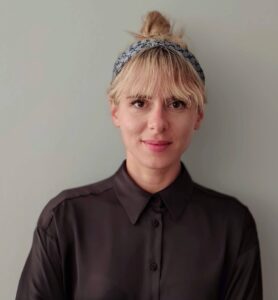
A Designer’s Perspective – Dr. Tina Katika, XR Division Leader
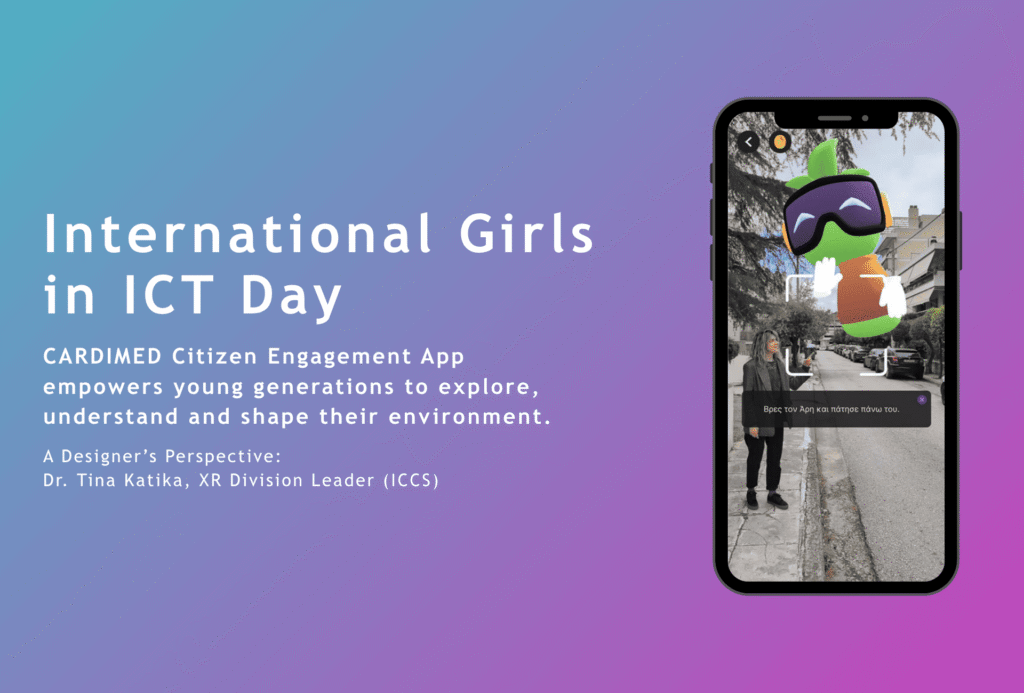
One of the key decisions in designing the CARDIMED citizen engagement app was to move away from text-heavy interfaces entirely. Instead, the team built spatial, visual-first interactions with icons, augmented reality cues, and guided flows, so that users can understand by seeing and doing, not by reading manuals. The principle behind this was straightforward: if your interface needs a tutorial, it has already failed the user.
The greatest challenge was what might be called “context variability”. The sheer diversity of languages, digital literacy levels, connectivity constraints, and cultural interpretations of environmental data across Mediterranean communities. Designing a single system that behaves intelligently across all of that, without becoming unwieldy, is a constant balancing act that never fully resolves.
Above all, the hope is that girls and young women who use the app leave feeling not just like users of technology, but shapers of it; with the confidence to question systems, contribute data, and build better ones.
Digital Literacy: The Foundation for the Future
Across CARDIMED’s demonstration communities, capacity building and digital literacy are central to the project’s strategy. Workshops, training programmes, and knowledge-transfer activities are designed to equip citizens with the skills to understand and use digital environmental tools. These activities recognise that technological tools are only transformative if the people they are built for can use them confidently and critically.
For girls growing up in the Mediterranean region today, digital literacy is a foundation for agency. Whether they go on to careers in environmental science, software development, public policy, or civic engagement, the ability to navigate, interpret, and contribute to digital systems will shape what futures are available to them. Investing in that literacy now is an investment in the climate solutions we will need tomorrow.
A Call to Action
On International Girls in ICT Day, ICCS and the CARDIMED project extend an invitation to educators, institutions, policymakers, and communities across the Mediterranean and beyond: let us create more pathways for girls and women to enter, shape, and lead the digital fields that are redefining how we respond to climate change.
The challenges ahead are vast, but so is the potential. Data platforms, dashboards, and citizen science tools are only the beginning. The next generation of climate innovators is already out there and our task is to ensure the door is open, the tools are accessible, and the welcome is genuine.
The future of climate resilience is digital. Let’s build it together, and let’s make sure every voice is in the room.