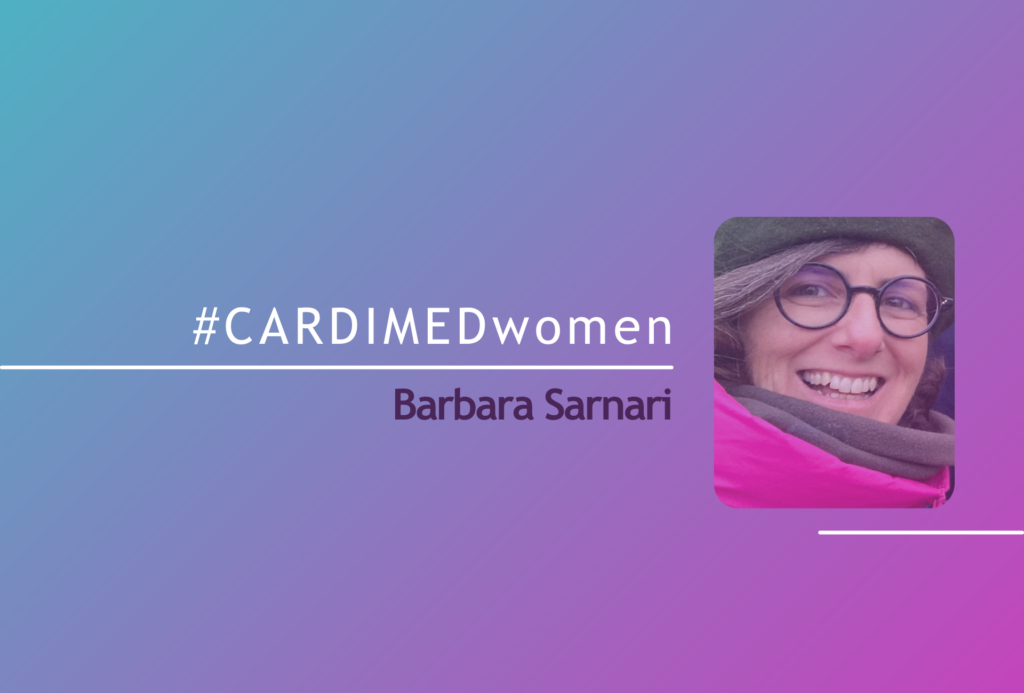
In our latest #CARDIMEDWomen interview, we shine a light on Barbara Sarnari, Vice-President of SVI.MED. and local coordinator of CARDIMED sub-DEMO4.2 in Ferla (Italy). With a background in mathematics and a lifelong commitment to environmental activism, Barbara brings a unique analytical and human-centred perspective to sustainability, climate adaptation and Nature-Based Solutions.
In this conversation, she reflects on how logic, observation and care for nature can come together in real-world action, from innovative water reuse systems to community engagement and education. Barbara also shares powerful insights on women’s leadership, the importance of diversity in decision-making, and why making sustainability understandable and accessible is essential for a just and resilient future.
PERSONAL & PROFESSIONAL BACKGROUND
Can you introduce yourself Barbara and your role in CARDIMED?
My name is Barbara Sarnari, Vice-President of SVI.MED., a non-profit organisation founded in 2003 and based in Sicily that focuses on sustainable development.
I hold a degree in mathematics, which has had a strong influence on my way of thinking and working. Although my academic path was not strictly environmental, I have always been interested in environmental challenges and how complex systems can be analysed and improved through structured, evidence-based approaches.
Through SVI.MED., I have been able to combine this analytical mindset with practical work on sustainability, climate adaptation, and nature-based solutions (NbS), translating theory into tangible actions.
Within the CARDIMED project, I am the local SVI.MED coordinator for sub-DEMO4.2 in Ferla.
What inspired you to pursue a career in science, sustainability, or innovation?
Even before I could walk, my parents used to take me with them when they collected rubbish from streets, beaches, and rivers. We would carry handmade posters saying, “Nature is beautiful! Don’t destroy it’. In a sense, I have always been an activist, motivated by education, curiosity and a connection to nature. This connection gradually led me to combine my passions for logic, observation and understanding reality with environmental and social issues. Mathematics has enabled me to understand complexity, recognise patterns and structures, and even when they seem abstract worlds. Often there is nothing to invent because nature has already done it for us… in a wonderful way. Just think about fractals! They are not only mathematical objects, but also found in nature, for example in the form of Romanesco broccoli!
Innovation is not just about creating something new, but also about rediscovering, observing, learning, imitating, and reinventing ourselves continuously as we adapt to, or respond to, changes in ourselves and the world around us. To me, life itself is science and sustainability. This is why I don’t see my career as something I deliberately chose, but rather as a way of life. Over time, my passions naturally became my work.
How did you first become involved in Nature-Based Solutions (NBS) and climate resilience?
When I started working at SVI.MED about 20 years ago, I was interested in a wide range of topics that I felt urgently needed attention. I was eager to study and learn not only what European programmes were asking us to address, but also the proposals of the scientific community. Over time, some of these themes became central to both my work and my personal motivation. I believe this is because I identify strongly with the Mediterranean community, rather than as a “privileged European”. Working closely with partners and communities in North Africa and the Middle East made me realise how crucial water is and how many things we take for granted, such as green public spaces where children can play, are not equally accessible everywhere.
I became particularly interested in the idea of wastewater as a resource rather than a problem. This has led me to collaborate with IRIDRA on several projects, in which I have explored the potential of constructed wetlands systems and, more broadly, nature-based solutions for water management and climate resilience.
To me, NbS represent the intersection of many urgent issues I feel passionate about today: water scarcity, climate adaptation, social equity, education, beauty and territorial care.
CONTRIBUTIONS TO CARDIMED
What is your main area of work within CARDIMED?
A few years ago, in a previous ENI CBC MED project called NAWAMED, IRIDRA designed and SVI.MED. installed a green living wall in Ferla, Syracuse, Sicily. This highly innovative system treats and reuses greywater. It was one of the first full-scale applications of this type in Europe and demonstrated how NbS can be effectively integrated into urban environments. Through CARDIMED, our work focuses on monitoring and evaluating the system’s performance over time, assessing its environmental, technical and operational outcomes, as well as its social impact and acceptability. The Ferla installation is one of the demo sites included in CARDIMED, and I am responsible for coordinating this activity locally, working closely with the Municipality of Ferla, IRIDRA, and the University of Catania.
How do you think your work contributes to climate resilience and sustainable water management?
I believe that dialogue and communication, as well as a constant connection between local experiences and the international scientific community, are essential for turning theory into practice. Only by working in real contexts can we truly understand the difficulties, limitations and opportunities of innovative solutions, and make scientific knowledge more accessible and real-life experience genuinely transferable.
In this sense, my role involves maintaining continuous relationships with local administrators and technicians and carrying out activities with citizens and students at the school where the green living wall has been installed. These interactions clearly demonstrate the significant effort required to bridge the gap between what appears ‘obvious’ on paper and what it takes to implement and maintain it.
WOMEN IN SCIENCE & INNOVATION
What challenges have you faced as a woman in this field, and how have you overcome them?
I often feel uncertain when answering this question. On the one hand, I truly believe that passion has no gender; believing strongly in what you do is often the most effective way to overcome differences and barriers.
However, I also recognise that reality is more complex. When I think back to the many meetings, site visits and public events where I was the only woman present, I realise that it never made me feel proud; it made me feel concerned. I was concerned because I knew that with such an imbalanced perspective, we wouldn’t get very far.
I don’t believe that one gender is superior to the other. However, many of today’s environmental problems, as well as much of the resistance to change, stem from a historically male approach to territory and resource management that is linear and unilateral.
What helped me overcome these challenges was working with an increasing number of women, beginning with the predominantly female SVI.MED staff, and establishing networks and fostering collaboration amongst them. On a personal level, I realised that credibility as a woman does not come from dressing ‘professionally’, thus conforming to expected standards. Instead, I learned to be proud of my presence, while never normalising the absence of diversity.
Over time, I became aware that my presence and approach were setting an example, particularly for women in contexts where inequalities were more apparent. I learned that, when a woman sits at a table with men and does not acknowledge or engage with the other women present, she may unintentionally reinforce the idea that their voices matter less. Therefore, recognising, listening to and supporting one another is not only a personal choice, but also a political and cultural responsibility.
What advice would you give to young women interested in working in sustainability, science, or innovation?
Yes, please! We need you! First, if you believe in climate change and are not a denier, then we are already on the same planet! So, my advice would be to trust your own perspective on the world, even when it does not align with dominant models, journals or politicians. Science, sustainability and innovation do not follow a single path, and there is no ‘correct’ profile for working in these fields. In fact, we need all disciplines to really apply a behavioural and economic/social change. It’s a huge challenge, long and difficult, but it’s a wonderful journey with wonderful people who believe in and are trying to build a better future!
How can we encourage more women to take leadership roles in environmental and scientific projects?
First, it is necessary to recognise that climate change, water scarcity and social fragmentation are complex issues requiring holistic, multi-perspective approaches.
Creating space for women in leadership involves changing narratives, governance structures and decision-making processes to recognise the value of cooperation, active listening and diversity. In an increasingly fragmented world, women can play a pivotal role in reconnecting people, knowledge and territories, and redefining the true meaning of leadership.
VISION & FUTURE GOALS
What are your hopes for the future of NBS and climate adaptation in Europe and beyond?
Firstly, I hope that Nature-based Solutions and climate adaptation continue to be discussed repeatedly without losing momentum. We cannot afford to take steps backwards, as is unfortunately happening in some areas of current adaptation policies. Political uncertainty breeds societal uncertainty, and in some cases, economic difficulties are deliberately framed as being caused by the innovations required to mitigate climate risks rather than by climate change itself. I also hope that Europe will learn to look beyond itself. I envisage a Europe that plays a strong and responsible role in the Mediterranean. A Europe that leads not through domination, but through care, resilience, and the ability to connect. This would be a Europe capable of learning from the resilience of Mediterranean peoples while sharing knowledge and innovation in fields such as water management and nature-based solutions.
I hope for a Europe that helps to transform the Mediterranean into a living hub of innovation and experimentation rather than a barrier between two worlds. This would be a space where climate adaptation becomes a shared project built on exchange, solidarity, and mutual learning.
How do you see the role of women evolving in science and environmental innovation?
I believe that women will play a pivotal role in fostering the multidisciplinary approach that is essential for the development of nature-based solutions, and more broadly, for innovation in science and environmental fields. Climate challenges cannot be addressed through isolated disciplines or purely technical solutions; they require an ability to connect knowledge, scales and perspectives, including societal innovation.
At the same time, women often demonstrate a strong sense of pragmatism, translating complex ideas into practical, real-world solutions. In a context of climate uncertainty, collaboration, long-term vision and attention to impacts over time are fundamental qualities, not secondary ones.
Our role will increasingly be to advance systemic and inclusive innovation while fighting many small, everyday battles to establish our equal place. It will not be easy. We are living in a period of social and political regression where rights and achievements cannot be taken for granted.
For this very reason, women’s presence in science and environmental innovation is not just desirable, it is necessary to ensure progress remains connected to care, responsibility, and the future of communities.
If you could change one thing in the way we approach sustainability, what would it be?
Beyond increasing female involvement, I would change the way we listen, particularly to young people. It’s not just about hearing their voices; it’s about truly listening to them, even when we don’t fully understand them. After all, they are the ones who will live in the “sustainable future” we are trying to create, and their perspectives often challenge our assumptions.
I would also strengthen the connection between science and remote and underrepresented areas, where universities and research centres are often absent, yet which will be hit hardest by the impacts of climate change.
Finally, I would radically simplify the language of sustainability. We should create roles within universities, research centres and projects whose task it is to translate scientific concepts, academic papers and policy documents into accessible language for citizens, decision-makers and communities.
If we fail to do this, we risk moving in one direction while society thinks, reacts and votes in another. Making sustainability understandable is not an optional extra; it is a democratic necessity.