How can cities remain attractive and functional while coping with increasing heat, drought and heavy rainfall? BABEG’s cooperation partner, the Austrian city of Villach in Carinthia, offers a practical answer. Through its “Grüne Achse” (Green Axis), the city combines urban greening with the sponge-city principle, transforming parts of its paved city centre into spaces where trees, soil and rainwater management work together.
The project is designed as a green connection between Villach’s main railway station and the city park. Implementation began in autumn 2022 with two sponge-city trees at “Standesamtsplatz”. Ten further trees were planted on the main square, with additional planting extending the Green Axis towards the railway station. After careful research, two different species each of oak and maple were selected based on the prevailing climate and the needs of the tree species. The project is based, among other things, on a heat study commissioned by the city, which identified areas where greening could contribute to climate adaptation.
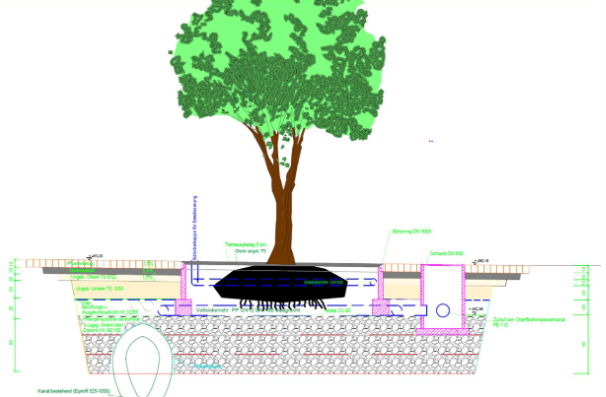
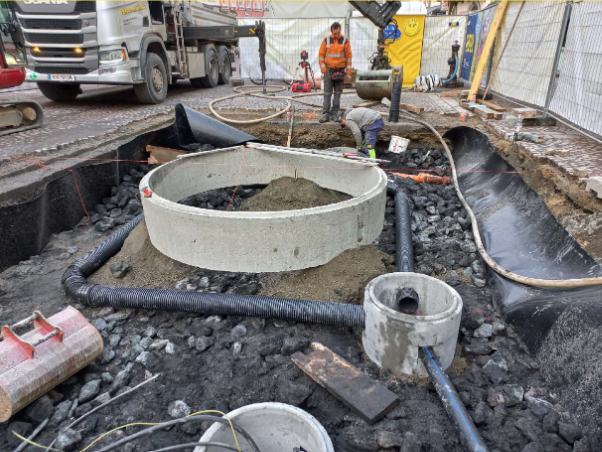
The key innovation lies below the surface. In conventional urban settings, trees planted in paved squares often have limited root space and restricted access to water. The sponge-city approach creates a larger underground growing volume, allowing roots to spread beneath paved areas while storing rainwater. Instead of immediately entering the drainage system, rainfall can be retained and made available to the trees during dry periods. At the same time, this can reduce pressure on drainage systems during heavy rainfall.
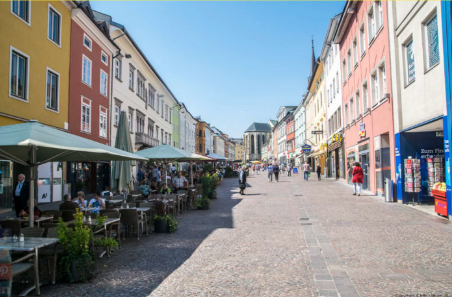
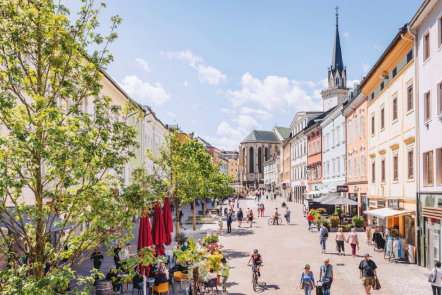
Villach’s main square illustrates how this principle can be integrated into a densely used urban space. The ten trees were planted in several construction phases between 2023 and 2025. Planning had to accommodate emergency access, existing utility infrastructure and events held on the square. Construction was coordinated with local businesses and residents, who were kept informed about progress through regular meetings. The project therefore demonstrates that climate adaptation requires more than planting trees: it involves coordinating water management, urban design, infrastructure and the use of public space.
The financial dimension is equally relevant. Villach established a tree-patronage scheme through which companies and other local actors could support individual trees and their maintenance. The redevelopment of the main square was reported to cost around €700,000, covering the trees and sponge-city infrastructure as well as other infrastructure works, including fibre-optic and district-heating connections. The climate-adaptation measure was thus integrated into a broader process of urban renewal.
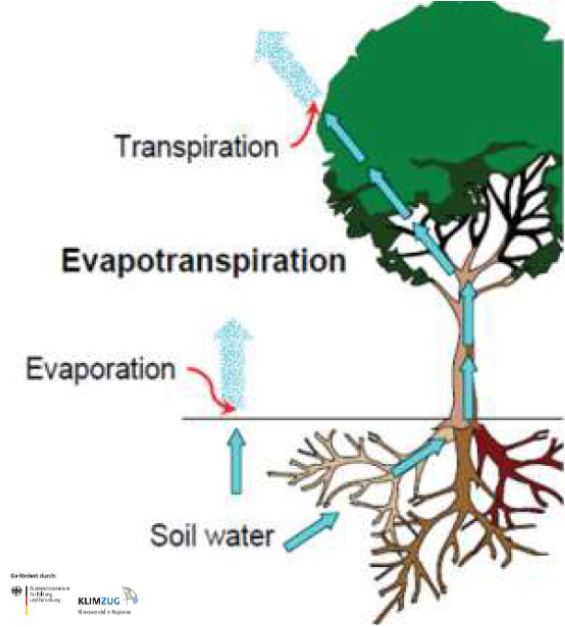
The benefits are multifunctional. Trees provide shade and cooling through evapotranspiration, improve the quality of public space and can contribute to urban biodiversity. At the same time, the sponge-city infrastructure retains water locally and supports the trees during dry periods. Villach therefore addresses several urban challenges through a single intervention, rather than treating greening, water management and public-space development as separate tasks.
This integrated approach makes Villach particularly relevant in the context of the CARDIMED project, where the wider adoption of Nature-based Solutions (NBS), combined with engineered infrastructure, digital tools and approaches that strengthen community and socio-economic resilience, is key. The trees in Villach are the visible element, but their performance depends on a less visible combination of soil volume, water storage, drainage, technical infrastructure and long-term maintenance. The project also connects climate adaptation with the everyday use of public space and the involvement of local economic actors.
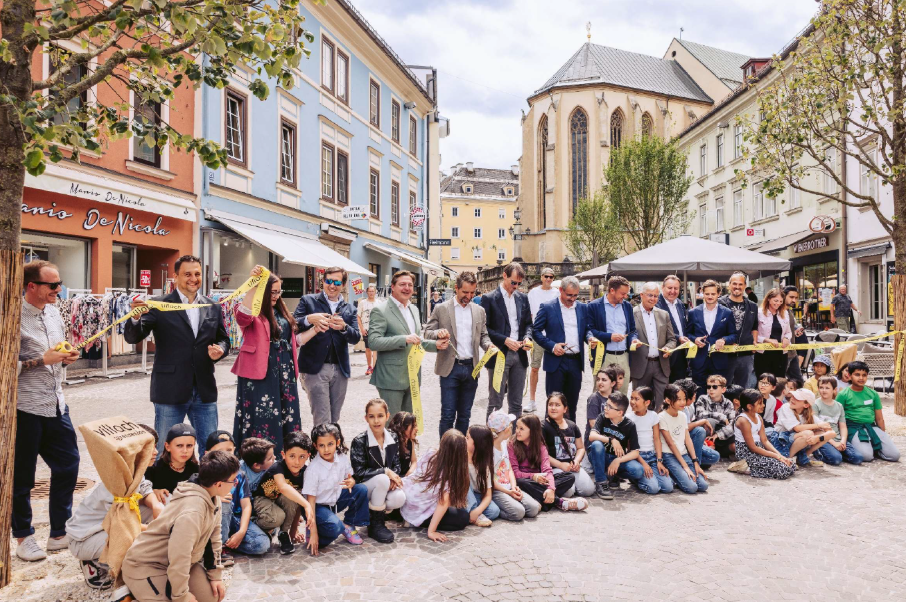
Participation and financing provide another connection with CARDIMED. In Villach, residents and businesses were involved in the implementation process, while tree sponsorship created an opportunity for local actors to contribute financially. Such arrangements can help embed climate-adaptation measures within the community rather than treating them solely as municipal infrastructure. CARDIMED similarly emphasises stakeholder engagement and the conditions that enable NBS to be adopted and maintained over time.
The most transferable lesson is therefore not the specific number or type of trees, but the process behind the intervention. A sponge-city solution must respond to local climate risks, soil and water conditions, underground infrastructure, patterns of public-space use and available resources. What can be shared across regions is the underlying methodology: identifying local needs, combining environmental and technical functions, involving relevant stakeholders, establishing viable financing and maintenance arrangements, and assessing the results.
Villach shows how a relatively simple urban element—a tree—can become part of multifunctional climate infrastructure. The sponge-city principle creates growing space and water storage; the Green Axis connects individual interventions into a wider urban strategy; and cooperation with local actors supports implementation. In this sense, Villach offers a valuable European example of the type of knowledge exchange promoted by CARDIMED: locally adapted Nature-based Solutions that address several challenges simultaneously and generate lessons that can be considered by other cities and regions facing increasing climate pressures. For the Carinthian innovation agency BABEG, a partner in the CARDIMED consortium, the city of Villach is also a valuable cooperation partner in supporting climate adaptation and resilience.