In Mediterranean agriculture, every drop of water matters; not only the water supplied to crops, but also the water that leaves cultivated fields. During rainfall and irrigation events, part of the water flows over the soil surface or drains through it, carrying substances applied or mobilised during agricultural activities. Nutrients from fertilisers, suspended solids, sediments and pesticide residues may therefore be transferred from fields to rivers, lakes, lagoons and coastal waters.
Unlike pollution released from a single and clearly identifiable source, agricultural runoff originates across extensive cultivated areas and varies considerably over time. A long dry period followed by intense rainfall, for example, can generate a short but concentrated pulse of contaminants. This diffuse and event-driven behaviour makes agricultural pollution particularly difficult to monitor and control.
The first line of defence is prevention. More efficient irrigation, careful fertiliser and pesticide management, crop rotation and other agroecological practices can reduce the amount of water and chemicals leaving agricultural land. However, preventing every loss is neither technically nor economically realistic. For this reason, measures placed at the edge of cultivated fields represent an essential additional barrier between agricultural production and the receiving environment.
Nature-based solutions (NbS) can provide this barrier by using vegetation, soil, water and microbial communities to intercept and treat runoff and drainage water through processes that occur naturally in ecosystems. Constructed wetlands, vegetated buffers, retention ponds and grassed waterways can slow water down, retain sediments, promote infiltration and support the biological transformation of pollutants. Rather than replacing sustainable farming practices, they complement them by acting on the fraction of contaminants that still leaves the field.
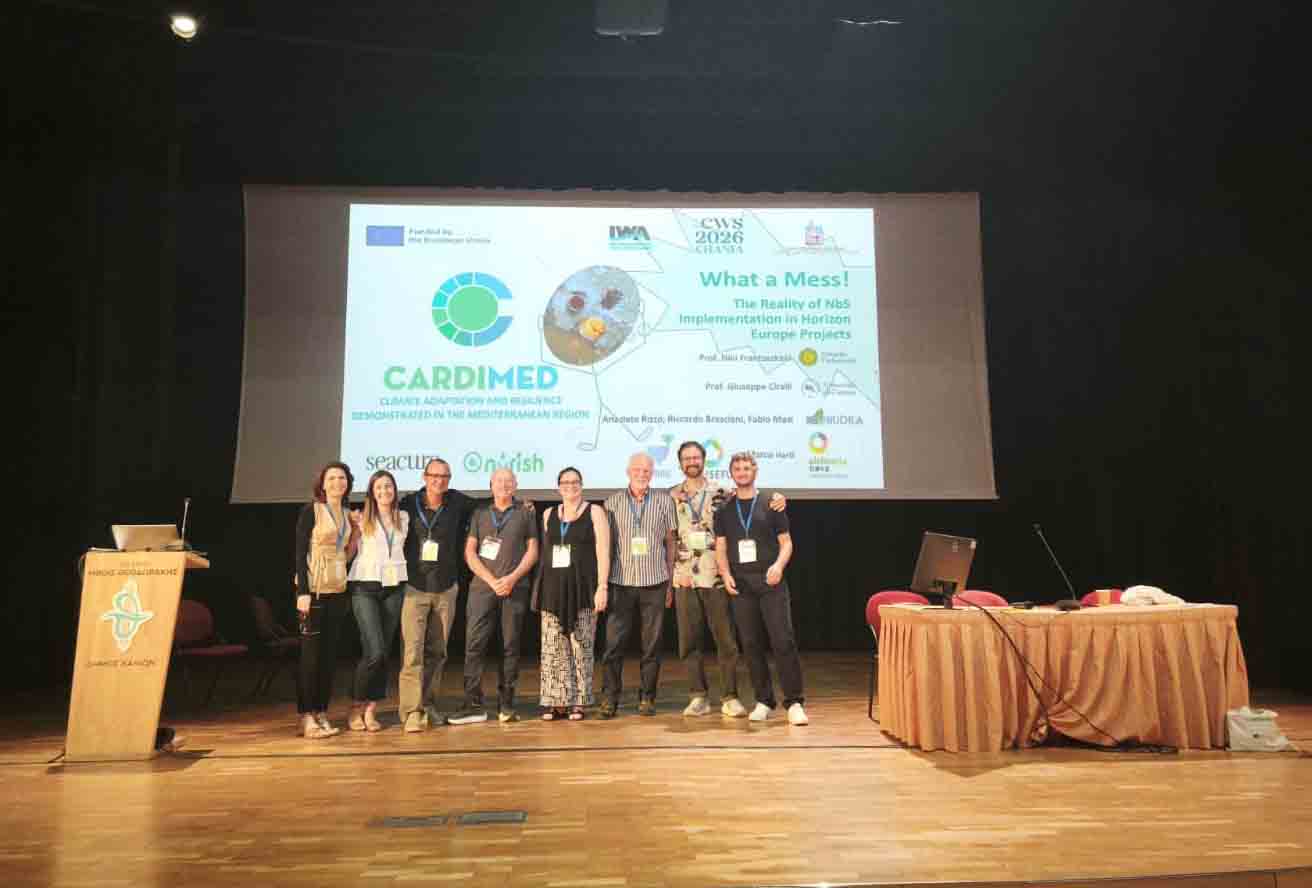
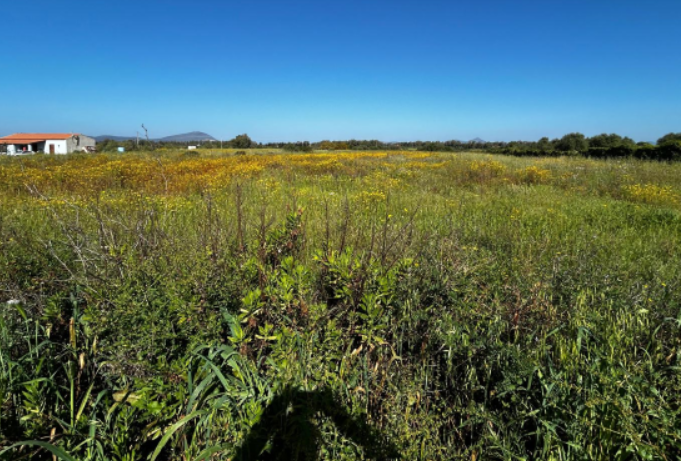
This approach is being put into practice within CARDIMED Demo 3, located in the peri-urban agricultural area of Alghero, Sardinia. Water scarcity, pressure on conventional water resources and the vulnerability of downstream aquatic ecosystems make this Mediterranean setting particularly suitable for demonstrating a more integrated model of agricultural water management.
The innovation of Demo 3 lies not in a single treatment unit, but in the connection of the entire water cycle. Municipal wastewater undergoes advanced tertiary and quaternary treatment to produce high-quality reclaimed water suitable for agricultural irrigation. Energy from photovoltaic panels supports the treatment processes, while the reclaimed water is used to irrigate crops managed according to sustainable agricultural practices. The drainage and surface runoff subsequently generated from the cultivated fields are collected and directed towards nature-based solutions before the water can reach the downstream environment.
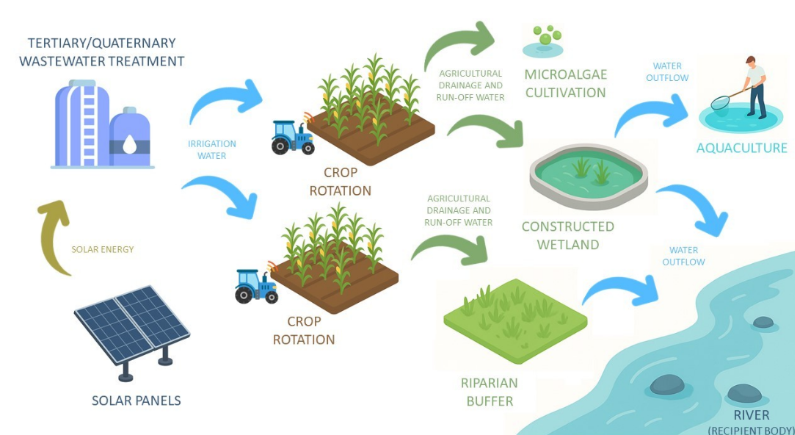
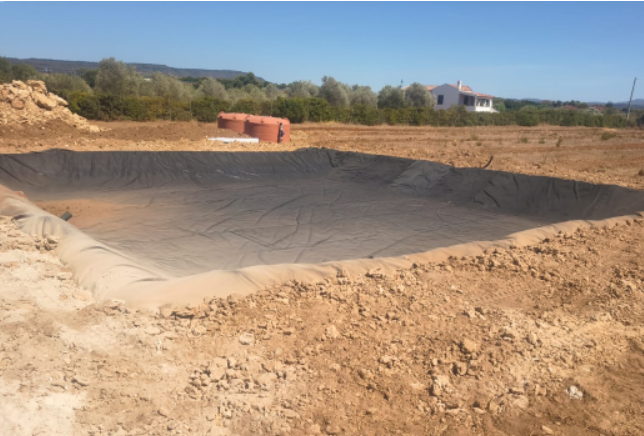
Two complementary nature-based solutions are being implemented to treat the agricultural runoff and drainage water generated within the demonstration site: a free water surface constructed wetland (FWS CW) and a riparian buffer (RB). Although they rely on many of the same natural processes, they interact with water in different ways. The constructed wetland gives runoff a dedicated space in which to slow down and remain in contact with water, vegetation and microbial communities. The riparian buffer instead transforms the edge of the field itself into a filtering and biologically active transition zone.
The free water surface constructed wetland covers an area of approximately 175 square metres. Its shallow basin is designed to reproduce, under controlled conditions, some of the ecological functions of a natural wetland and will be planted with Phragmites australis, an emergent macrophyte widely used in water-treatment wetlands.
As runoff enters the system, the reduction in flow velocity favours the settling of suspended solids and the contaminants associated with them. Contact with the soil, plant surfaces and organic matter promotes the retention of phosphorus and other compounds, while biofilms developing on submerged surfaces support the microbial transformation of pollutants. Nitrogen can be removed through interconnected processes such as plant uptake, nitrification and denitrification, while vegetation also contributes to stabilising the system and creating diverse aerobic and anaerobic microenvironments.
The second solution is a 150 square metres riparian buffer established at the downstream edge of an adjacent cultivated field and vegetated with perennial grasses. Here, runoff and drainage water are not retained within a basin. Instead, they are distributed across a strip of vegetated soil before leaving the agricultural area.
As the water crosses the riparian buffer, stems and leaves reduce its velocity, while the dense vegetation and soil surface physically filter suspended material. The longer contact with soil and root systems favours infiltration, adsorption and nutrient uptake, as well as microbial processes capable of transforming nitrogen and other pollutants. The vegetation also protects the soil against erosion, helping to reduce both the mobilisation of sediment and its transport towards downstream water bodies.
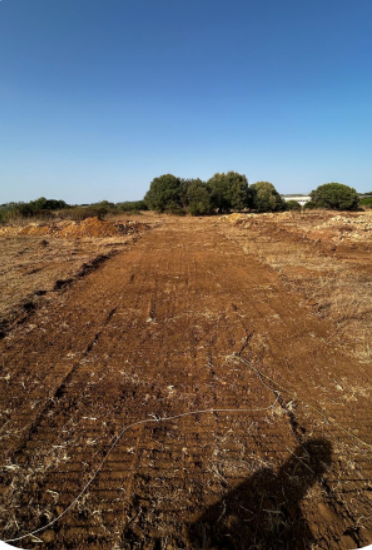
The two systems are positioned on neighbouring and comparably managed fields irrigated under the same conditions. This arrangement provides an especially valuable opportunity: rather than assessing each nature-based solution in isolation, Demo 3 will generate evidence on how two different strategies perform under similar agricultural and climatic conditions.
The comparison will help identify not simply which system removes more pollutants, but how their performance changes in response to runoff and drainage water volumes, contaminant load, seasonality, vegetation development and hydraulic conditions. These aspects are particularly important in Mediterranean environments, where prolonged dry periods alternate with intense rainfall events and runoff may occur in short, highly variable pulses.
Water will be monitored before and after passage through each nature-based solution. The assessment will consider organic matter, suspended solids, nitrogen and phosphorus compounds and general physicochemical water-quality parameters, together with selected pesticides and microbiological indicators where relevant. The establishment of vegetation and the hydraulic functioning of both systems will also be followed over time. This combined monitoring approach is essential because treatment efficiency depends not only on pollutant concentrations, but also on how water moves through the system and how the living components of the solutions develop.
The role of these nature-based solutions does not necessarily end with the protection of receiving water bodies. Within CARDIMED Demo 3, the effluent from the constructed wetland will be conveyed to an aquaculture system, where the quality of the treated water and its suitability for this further use will be evaluated. This additional step extends the integrated water chain beyond runoff treatment alone. More broadly, provided that the required water-quality standards and risk-management measures are met, water treated by edge-of-field nature-based solutions could also be recovered for further agricultural irrigation instead of being discharged. Although this additional irrigation loop is not implemented within CARDIMED, it represents a potential future development towards a system in which the same water resource can support several successive uses before its final return to the environment.
The benefits being investigated extend beyond water purification. The constructed wetland and riparian buffer can create new habitats within an agricultural landscape, support biodiversity and ecological connectivity, stabilise soil and contribute to the mitigation of peak runoff. Their vegetation may also represent a manageable biomass resource, potentially supporting nutrient recovery, composting or energy production where its characteristics and local management conditions allow.
Most importantly, these solutions operate with limited energy requirements and rely on ecological processes that can adapt and develop over time. Their real value will therefore be measured not only by their capacity to reduce pollutant concentrations, but also by their robustness, land requirements, maintenance needs and ability to remain effective under Mediterranean climatic conditions.
By connecting advanced water reclamation, renewable energy, agricultural irrigation, runoff/drainage water treatment and aquaculture, CARDIMED Demo 3 moves beyond a conventional “use and discharge” model. The free water surface constructed wetland and the riparian buffer act as key downstream treatment barriers, while the aquaculture system adds a further step for evaluating the quality and potential reuse of the treated water. Together, these components demonstrate how water can be treated, used and assessed across multiple stages, reducing pressure on conventional water resources and limiting the transfer of agricultural pollutants to sensitive downstream ecosystems.
The knowledge generated in Alghero will support the design and replication of these nature-based solutions in other Mediterranean agricultural areas facing similar pressures. In this way, the two systems are more than individual treatment units: they are part of a broader transition towards farming landscapes in which water reuse, pollution control, climate resilience and ecosystem protection are planned together.
Giuseppe Mancuso¹, Sofia Zantedeschi¹, Lorenzo Tombolini², Ike Olivotto³, Paola A. Deligios³, Luigi Ledda³, Francesco Fatone², Attilio Toscano¹
¹ Department of Agricultural and Food Sciences (DISTAL) – Alma Mater Studiorum – University of Bologna, Bologna, Italy
² Water and Waste Environmental Engineering Lab (WWEELab), Department of Materials, Environmental and Urban Sciences and Engineering (SIMAU), Marche Polytechnic University, Ancona, Italy
³ Department of Agricultural, Food and Environmental Sciences (D3A), Marche Polytechnic University, Ancona, Italy